Rules of engagement
Black Hawk DownThe Rules of engagement set the stated limits on when the Rangers could fire, but the Battle of Mogadishu exposed how hard those limits were to maintain amid a crowded, escalating fight. Their strain is central to the account’s contrast between formal restraint and battlefield conditions in which armed people, women, and children could be close together.
Initial Limits and Their Strain
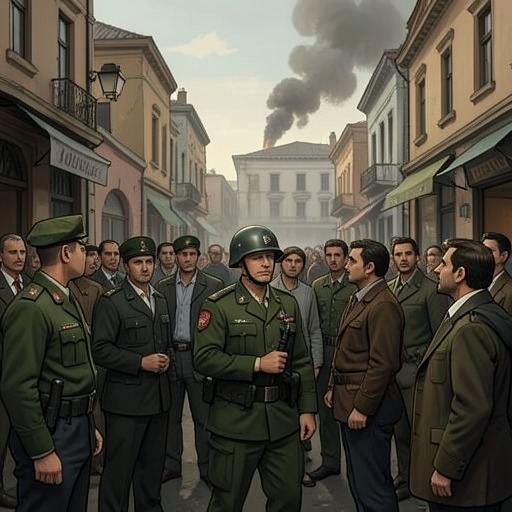
On October 3, 1993, U.S. forces entered the Bakara Market area to capture two lieutenants of Mohamed Farrah Aidid, whose Habr Gidir clan had challenged the United States. The daylight raid was a calculated risk in a neighborhood described as a stronghold of Aidid’s supporters. Rangers were instructed to shoot only at someone who pointed a weapon at them. But as gunfire drew crowds into the streets, people with weapons were intermingled with women and children; the crowd also included people who had come to witness the disturbance. The account links the difficulty of distinguishing threats from civilians not only to the immediate scene but to the widespread hatred stirred by earlier Ranger missions. The rule remained clear in its wording, while the circumstances made its application increasingly fraught.
The Rule Breaks Down in the Convoy
During the convoy’s passage through an alley, a woman in a flowing purple robe ran past the driver’s side of a truck. The driver had his pistol resting on his arm and was firing at whatever moved. Eric Spalding urged him not to shoot because the woman had a child; then she turned, still holding a baby on one arm, and raised a pistol with her free hand. Spalding shot her where she stood and fired four more rounds before she fell. The convoy moved on without confirming whether the infant had been hit. Spalding feared that he had struck the baby, a possibility made all the more stark by the fact that he had first recognized the child as a reason to hold fire.
Abdikarim’s account of the streets offers another view of the same perilous uncertainty. Near the shooting, he saw an American soldier bleeding from the leg and trying to hide by the road. When a woman ran in front of Abdikarim, the soldier fired in their direction; the woman was hit but got off the street. A Little Bird helicopter then swept low through an alley, firing as Abdikarim pressed himself against a wall, while armed Somali men ran toward the corner to shoot at the American. The scene places civilians, an injured soldier, helicopter fire, and armed men in rapid succession, without making the danger to people in the street disappear.
As the battered column fought its way back toward the base, the restraints gave way more completely for Dale Sizemore. The account states that the Rules of engagement were off. He saw boys seven or eight years old, some carrying weapons and some not, and shot them; he also fired into crowds of women running alongside riflemen. Numb, angry, and intent on bringing his friends back safely, he no longer cared whether he was shot and wanted to hit as many Somalis as he could. His actions mark a change from a rule that required identifying a person pointing a weapon to firing at people whose armed status was mixed or absent.
The images of a dead American being dragged through the street sharpened the prospect of further abandonment. After watching the footage, Paul Howe was ready to return and kill as many Somalis as he could; he rejected any further observance of the Rules of engagement and the moral boundary they represented. The account records this as his declared intention, not as a description of what he subsequently did. Together, the convoy scenes show the rule’s erosion under immediate threat, while Howe’s response shows how the sight of violence against the dead could turn that erosion into an explicit rejection of restraint.
Restraint, Fear, and Command
The rules governing fire operated alongside another pressure: the expectation that Rangers would keep going despite fear. When Brad Thomas told Struecker he could not return to the fight, Struecker spoke quietly with him rather than exploding or dismissing his fear. He acknowledged that he was scared too, but appealed to their duty; Thomas eventually climbed aboard the vehicle. The episode distinguishes the discipline of continuing a mission from the separate question of whom a soldier could shoot, while showing how unit expectations could shape conduct under extreme pressure.
Sean Watson’s challenge to an order to move out shows that obedience, too, was not automatic. He warned that the group would face bullets and grenades, that five wounded men—including two who had to be carried—and the body of Earl Fillmore would make the party slow and conspicuous, and that their defended courtyard would be difficult to overrun. His objection was a tactical assessment, not a rejection of the firing rule. Set beside the moments when soldiers described that rule as impossible to sustain or explicitly abandoned it, the disagreement shows how the battle tested distinct forms of restraint: control over fire, judgment about risk, and the pressure to obey.
Rearmament and the Unresolved Boundary
After being flown back to the hangar, the commandos cleaned their weapons, checked their equipment, and replenished their ammunition; they were ready to go out again. The account gives no further firing decision here, but the preparations leave the Rules of engagement unresolved: the soldiers were equipped for a return to combat after the battle had exposed how difficult restraint could be to preserve.